
How 3D Laser Scanning is Transforming Building Reconstruction
“To restore the past, we must first see it — in every detail.”
Reconstruction is no longer a process of guesswork and manual measurement. Today, 3D laser scanning technology allows engineers, architects, and restorers to capture the physical reality of a building with millimeter precision. At Enerplan, we integrate laser scanning into every complex restoration and modernization project — from historical landmarks to industrial facilities — ensuring that every detail is documented, analyzed, and preserved.
“Restoring precision, preserving heritage.”
What is 3D Laser Scanning?
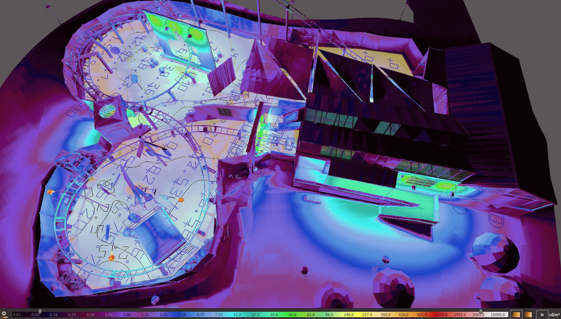
3D laser scanning is a non-invasive technology that uses laser beams to collect millions of spatial data points per second, creating a high-resolution digital replica of any structure. The result is a detailed point cloud that forms the foundation for BIM modeling, digital reconstruction, and structural analysis. This method replaces traditional surveying, reducing human error and drastically improving accuracy and speed.Precision for heritage restoration
When dealing with cultural monuments or heritage buildings, traditional surveying methods often fail to capture the subtle deformations or irregularities that define centuries-old structures. Laser scanning, however, can record every curvature, crack, and texture — providing invaluable data for architects and conservators. Enerplan has applied this technology in numerous restoration projects, combining laser scanning with BIM modeling to create accurate digital twins. These virtual models allow stakeholders to explore every aspect of the building before physical intervention, ensuring safety, cost efficiency, and respect for historical authenticity.Industrial and structural applications
Beyond heritage sites, 3D laser scanning has become indispensable in modern industrial and commercial projects. It supports retrofit design, expansion planning, and quality control for large manufacturing facilities and logistics centers. Enerplan’s engineers use scanning to verify as-built conditions, detect structural deviations, and coordinate complex MEP systems in existing buildings. Through integration with BIM platforms, the scanned data becomes a shared digital environment — enabling architects, engineers, and contractors to collaborate seamlessly and avoid costly on-site surprises.Data-driven design and efficiency
Each laser scan generates millions of data points that can be processed into highly accurate 3D models. These models serve as a reliable basis for decision-making, simulations, and maintenance planning. Whether restoring a historic façade or upgrading a production hall, data precision shortens project timelines, minimizes material waste, and ensures predictable outcomes. Enerplan’s scanning workflow includes drone-assisted photogrammetry for hard-to-reach areas, ensuring comprehensive digital documentation from roof to foundation.Advantages of 3D Laser Scanning
- 🕐 Speed: Thousands of square meters can be scanned in just a few hours.
- 📏 Accuracy: Millimeter-level precision eliminates manual measuring errors.
- 💾 Data integration: Easy import into CAD, Revit, and BIM platforms.
- 🌿 Non-invasive: Ideal for fragile or sensitive heritage structures.
- 💡 Visualization: Enables immersive 3D navigation and analysis.
From documentation to digital transformation
3D laser scanning is not just a tool for documentation — it’s a gateway to digital transformation in the construction and restoration industry. It bridges the gap between the physical and the digital, providing a foundation for predictive maintenance, energy modeling, and future renovations. For Enerplan, this technology ensures that every project begins with a deep understanding of the existing structure — a critical step toward lasting and sustainable reconstruction.Looking ahead
As Serbia and the wider region embrace advanced engineering practices, 3D laser scanning will continue to play a central role in shaping a smarter, safer, and more efficient built environment. Enerplan remains committed to leading this evolution — combining technical precision, digital innovation, and architectural sensitivity to honor the past while building for the future.“Restoring precision, preserving heritage.”

